

Many aspects of healthcare access in Canada are based on where you live. Access to genetic testing for hereditary cancer is no exception. To assess and illustrate this, we reached out to our community and spoke to five women to map where they would and would not be eligible to access genetic testing in Canada in the present day.
We asked these women about their personal and family health history based on the genetic testing eligibility criteria of provinces and territories (PTs) that had this information online and publicly available. In focusing on just public information that is online, we recognize that our findings are based only on this information. In other words, a PT might have eligibility criteria that can be gotten from a genetic counsellor but not posted online. We choose to focus on just online information because many people get their health information online and we wanted to reflect what individuals can find out about their own access.
Specifically, Manitoba, Newfoundland and Labrador, Northwest Territories, Nunavut, and Saskatchewan do not have publicly available information online on how a person may be eligible to access hereditary cancer genetic testing. Therefore, this series comments only on eligibility access in Alberta, British Columbia, New Brunswick, Nova Scotia, Ontario, Prince Edward Island, Quebec and Yukon.
It is also important to note that Yukon Territories uses the same eligibility criteria as British Columbia, while New Brunswick, Nova Scotia, and Prince Edward Island share the same eligibility criteria.
Let’s meet Mykah Obrigewitch and explore where she may or may not be eligible to access genetic testing for hereditary cancer in Canada.
About Mykah Obrigewitch
Mykah Obrigewitch lives in Alberta, is 19 years old, and has a family history of breast cancer. Her mother and aunt were both diagnosed with triple negative breast cancer (TNBC) in their early 30’s. A year after being diagnosed with breast cancer, Mykah’s mom was diagnosed with the BRCA1 genetic mutation. Breast cancer then became a very strong subject in her family – Mykah’s mother taught her and her three sisters all about the BRCA1 gene mutation and breast cancer. Two out of three of Mykah’s sisters also tested positive for the BRCA1 gene mutation, and they both underwent double mastectomies and reconstruction.
Given her family’s history with the BRCA1 gene, her family doctor typically sends referrals and orders bloodwork once Mykah’s family members request it at age 18. When Mykah turned 18, she began asking for a referral to be tested for the BRCA1 mutation. However, when it came time for Mykah’s testing, the process became unexpectedly complicated. She describes this experience as “a bit of a wild ride”.
Mykah’s doctor told her she needed approval from the genetics clinic before her could send a referral. The clinic said they could not collect a sample without receiving that referral first. At one point, a fill-in doctor gave her a regular bloodwork requisition and simply wrote “BRCA1 testing” on top in black pen, but that wasn’t sufficient. Mykah’s sample was stored in the lab for nearly a year. Finally, she received a call from a genetic counsellor letting her know the correct referral had come through and that the bloodwork could be redone. Four months later, her results came back positive for BRCA1 gene mutation at the young age of 19. Months into learning that she is positive for the BRCA1 gene mutation, Mykah is still waiting to hear back from several surgeons regarding referrals for a double mastectomy and reconstruction, with one referral already being denied.
In Mykah’s Own Words
“The experience was frustrating because I felt I had to advocate for myself at every step, and I couldn’t understand why the process was so different from what my sisters went through.
It was quite surreal to be confirmed positive with the BRCA1 gene mutation at such a young age, even though it felt like my mother had prepared me for this moment my whole life. It put a huge roadblock in my life that I feel only surgeons can move. At the end of the day, how can I really move forward with my life knowing that I’ll have to undergo a huge surgery soon? If I do not get surgery, then the other option is to be monitored regularly. Unfortunately, surgeons are very iffy about giving mastectomies to girls at such as a young age. Going through this experience feels as though you can never be too young to get cancer, but perhaps you can be too young to prevent it.”
Where Is Mykah Eligible to Access Hereditary Cancer Genetic Testing in Canada?
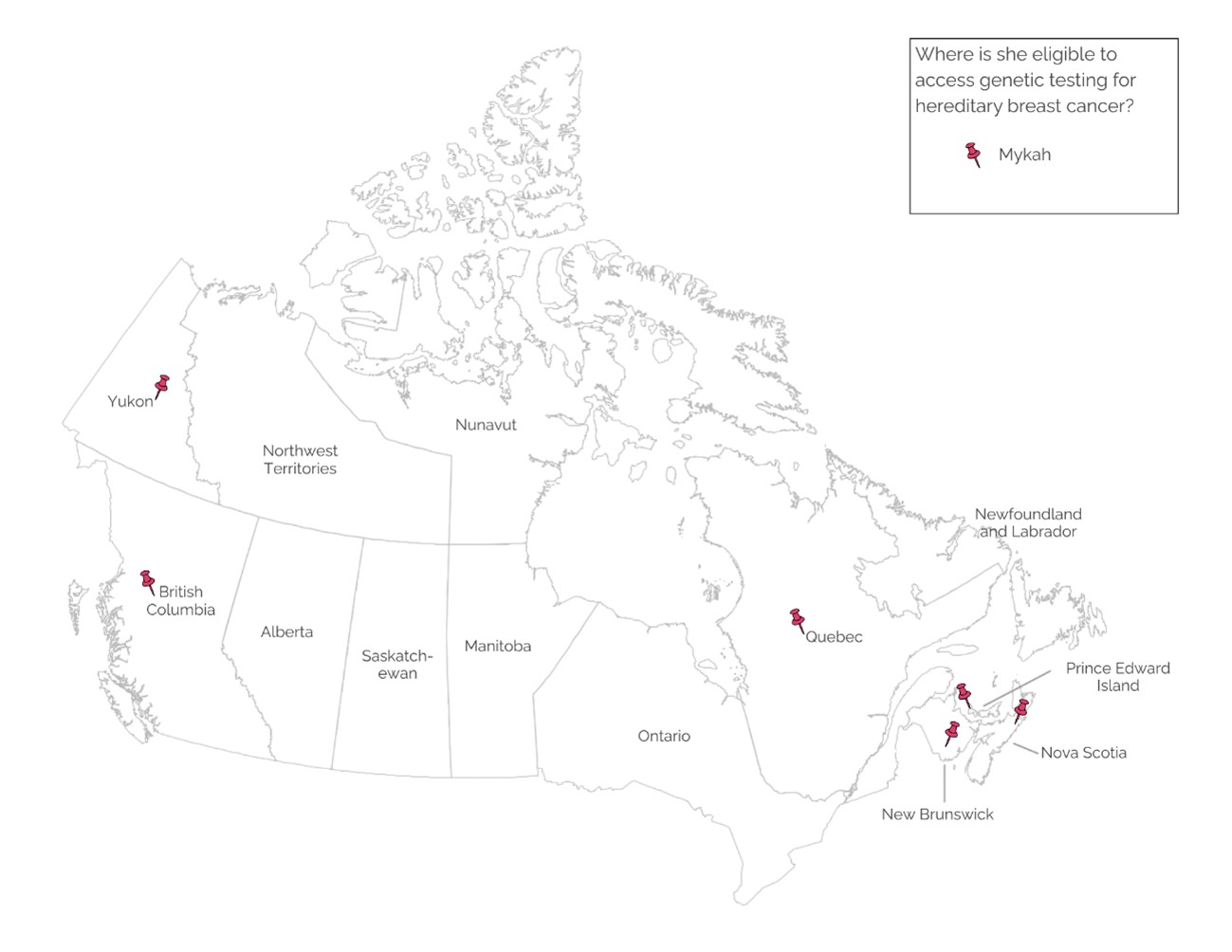
Based on publicly available information on the eligibility criteria to access genetic testing for hereditary breast cancer, Mykah is eligible to access testing in British Columbia, New Brunswick, Nova Scotia, Prince Edward Island, Quebec, and Yukon.
British Columbia and Yukon
Mykah is eligible to access genetic testing in British Columbia and Yukon based on her personal health history because she meets the criteria of having a confirmed hereditary cancer gene mutation found through a private pay genetic testing or a research study. This means that Mykah’s access to hereditary cancer genetic testing is based on the fact that she is already confirmed to have a genetic cancer mutation.
Even if Mykah did not yet have a confirmed hereditary cancer gene mutation, she is still eligible for testing in British Columbia and Yukon. In order to be eligible to access genetic testing in British Columbia and Yukon, a person needs to have a close relative on the same side of the family that meets one of the personal health history factors or they would need to meet at least two of the family health history criteria. Mykah is eligible to access testing in British Columbia and Yukon because she has a close relative on the same side of the family that meets one of the personal history factors. She also meets at least two of the family health history criteria. Specifically, she meets the following family health history criteria:
- Cancer at an age earlier than is common for that type of cancer, in close relatives on the same side of the family
- Multiple close relatives on the same side of the family with the same type(s) of cancer
- Cancer in over more than one generation, in close relatives on the same side of the family
- Confirmed hereditary cancer gene mutation
- A close relative on the same side of the family with a less common cancer
New Brunswick, Nova Scotia, and Prince Edward Island
While Mykah does not meet any of the personal health history criteria, she meets two of the family health history criteria. Specifically, she meets the following family health history criteria:
- Two or more 1st and/or 2nd degree relatives diagnosed with breast cancer younger than 50
- Confirmed BRCA1 or BRCA2 gene mutation in a blood relative
Because of this, Mykah would be eligible to access hereditary cancer genetic testing in New Brunswick, Nova Scotia, and Prince Edward Island.
Quebec
While Mykah does not meet any of the personal health history criteria, she meets the following two-family health history criterion that would make her eligible to access genetic testing in Canada:
- 2 close relatives on the same side of the family diagnosed with breast cancer younger than 50
- Family with a BRCA1 or BRCA2 gene mutation
Where Is Mykah Not Eligible to Access Hereditary Cancer Genetic Testing in Canada?
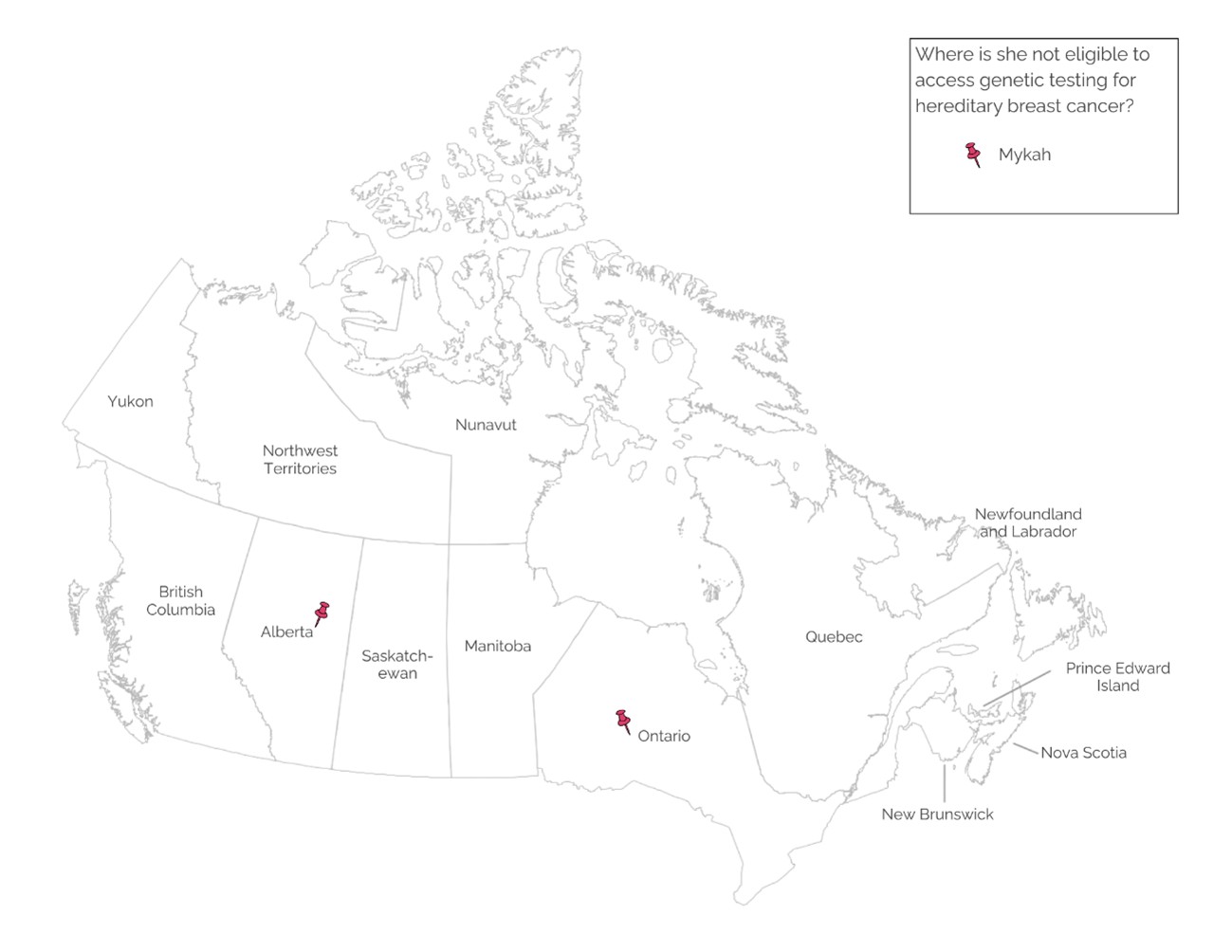
Based on publicly available information on the eligibility criteria to access genetic testing for hereditary breast cancer, Mykah is not eligible to access testing in Alberta and Ontario.
Alberta
In Alberta, all the personal health history eligibility criteria require a personal history of a breast cancer diagnosis. Similarly, all but one of the family health history criteria require meeting the given family history criteria and having a personal history of a breast cancer diagnosis. The one criterion that does not require a personal history of a breast cancer diagnosis requires the person to be of Ashkenazi Jewish heritage. Since Mykah is not of Ashkenazi Jewish heritage, she does not meet any of the family health history eligibility criteria. Therefore, she does not meet the eligibility requirements of access hereditary cancer genetic testing in Alberta, even with the confirmed genetic BRCA1 mutation in her family.
Ontario
Just like Alberta, all the personal health history eligibility criteria in Ontario requires a personal history of a breast cancer diagnosis. Since Mykah has not been diagnosed with breast cancer, she is not eligible to access testing in Ontario based on her personal health history. She is also not eligible to access genetic testing in Ontario based on her family health history, even with a cancer gene mutation confirmed in multiple family members. This is because all the family health history criteria require meeting the given criteria and having a personal history of a breast cancer diagnosis.
In this blog series, we see just how much access to healthcare in Canada can be determined simply because of where a person lives. Canada needs eligibility criteria that are the same across the country. Individuals concerned about hereditary cancer and people diagnosed with breast cancer cannot be at the mercy of their postal code determining their health and access to adequate healthcare.
Not only should access to genetic testing be the same across Canada, but it should also be updated to ensure it reflects our latest knowledge of hereditary breast cancer and gene mutations. Sources like the Canadian Recommendations for Germline Genetic Testing of Patients with Breast Cancer: A Call to Action should be consulted to develop standardized, inclusive, guidelines that don't let people fall through the cracks. Tied in with this is the importance of testing a large number of gene mutations that have been associated with breast cancer, not just the BRCA1 and BRCA2 gene mutations. Once developed, the eligibility to access genetic testing should be posted online and made publicly available by all provinces and territories.
Additionally, where the five women we spoke may or may not be able to actually access genetic testing is just for illustrative purposes. We only show where they meet the eligibility criteria that has been set and made publicly available by each PTs. It does not reflect their actual access to genetic testing for hereditary cancer as there may be further access criteria. For example, in some places a person can get genetic testing automatically if they meet the criteria, while in others, a referral from a doctor might be needed. This is shown in Mykah’s case where she does not meet the eligibility criteria in Alberta, where she lives, but was still able to get tested, although with a lot of bumps along the way.
Genetic testing is an important part of both prevention and treatment. It is important that access to genetic testing in Canada reflects this.


 Receive updates by email

