
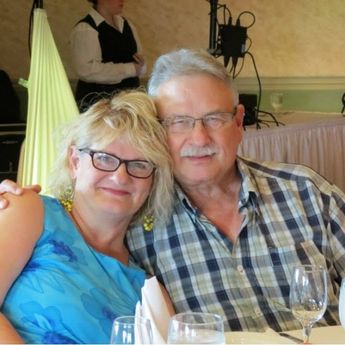
 When Jill turned 50, breast cancer was the last thing on her mind. Living in Halifax, Nova Scotia, she was enjoying life as a newly trained paralegal, wife, mother of three, and grandmother. Breast cancer did not run in her family, and she had no reason to think that her life was about to change.
Then, during a routine breast exam, her doctor found something concerning. In March 2011, just one month after her 50th birthday, Jill was diagnosed with Stage IIIB invasive lobular breast cancer. "The diagnosis was mind-numbing, unbelievable, and terrifying," she recalls.
Facing Treatment
Treatment began quickly. She had a single mastectomy, chemotherapy, radiation therapy, five years of tamoxifen, and five years of exemestane.
Jill faced both fear and uncertainty, but she made a conscious decision about how she would approach this disease. "I kept a positive attitude and did everything I was asked to do. I kept thinking, 'I can do this; I will do this.'"
She took medication to help manage nausea, but she experienced extreme fatigue and the loss of her hair. These side effects proved to be more difficult. "My hair was long most of my life and was my pride and joy. Also, being bald was an outward sign to show people you had cancer; people were kind, but I did not want their pity."
To cope, she reminded herself that her hair would grow back, wore a wig when she wanted or needed to, accepted help from others, and allowed herself to rest.
"I learned not to worry about doing everything. Just go with it."
The Impact Beyond Treatment
Like many others, the effects of breast cancer went beyond her treatment.
Physically: life after a mastectomy had its challenges. "Having only one breast made clothing hard to fit, and I had to give up certain necklines. Finding a bra and a weighted prosthesis was a nightmare."
Emotionally: she allowed herself to feel sadness without letting it take over. "Occasionally I would cry a little, but I made sure I did not feel sorry for myself. It can happen to anyone. Don't ask 'Why me?' Ask 'Why not me?'"
Spiritually: the experience deepened her faith. "I prayed a lot more and became closer to God in many ways. I became more spiritual."
The diagnosis also affected her career. Just four months after starting her dream job as a paralegal, she had to tell her employer that she needed a five-month medical leave. Fortunately, she had a very supportive employer who stood by her. "He kept me on, and I am still there 15 years later."
When she returned to work, having something meaningful to focus on helped her move forward. "My job kept me busy and focused on other things besides cancer."
Leaning on Support
Throughout treatment, one person stood firmly by her side: her husband. The experience brought them even closer together. "He is my best friend and ‘rock’. He was so loving and supportive throughout treatment and continues to be."
The diagnosis was hard on her kids, who were 19, 22, and 24 at the time. But they also rallied around her, and close friends offered support when she needed it the most.
She also found comfort in reading positive stories from other people who had experienced breast cancer. "It was helpful to read positive stories from other women and men online."
Fifteen Years Later
Today, 15 years after her diagnosis, Jill has no evidence of disease (NED). Rather than living with fear of recurrence, she focuses on enjoying her life. "I love my life. I don't worry that it will happen again. My husband told me that if it did, we would just deal with it like before. I couldn't agree more."
She feels fortunate and determined to make the most of every day. One lesson she carries with her is that breast cancer does not have to define the future. "It will be over one day. You will feel like your old self again. Nothing will ever scare you again. If you can face cancer, you can face anything."
Her Message for Others
When asked what message she would like to share with others facing breast cancer, her answer is simple:
"Stay positive. If you find it hard to stay positive, then just refuse to be negative. Your outlook matters. Educate yourself. Ask questions of your oncologist (there are no stupid questions). Go to Canadian websites such as CBCN for valid information. There are also many books available at local libraries, and they even have cookbooks for people undergoing chemotherapy treatment. Educate!)
As she reflects on her experience, one quote has stayed with her: "Life is not a journey to the grave with the intention of arriving safely in a pretty and well-preserved body, but rather to skid in broadside, thoroughly used up, totally worn out, and loudly proclaiming, WOW!! What a ride!"
Today, 15 years after her diagnoses, those words highlight the way she chooses to live.

 Receive updates by email

