

Many aspects of healthcare access in Canada are based on where you live. Access to genetic testing for hereditary cancer is no exception. To assess and illustrate this, we reached out to our community and spoke to five women to map where they would and would not be eligible to access genetic testing in Canada in the present day.
We asked these women about their personal and family health history based on the genetic testing eligibility criteria of provinces and territories (PTs) that had this information online and publicly available. In focusing on just public information that is online, we recognize that our findings are based only on this information. In other words, a PT might have eligibility criteria that can be gotten from a genetic counsellor but not posted online. We choose to focus on just online information because many people get their health information online and we wanted to reflect what individuals can find out about their own access.
Specifically, Manitoba, Newfoundland and Labrador, Northwest Territories, Nunavut, and Saskatchewan do not have publicly available information online on how a person may be eligible to access hereditary cancer genetic testing. Therefore, this series comments only on eligibility access in Alberta, British Columbia, New Brunswick, Nova Scotia, Ontario, Prince Edward Island, Quebec and Yukon.
It is also important to note that Yukon Territories uses the same eligibility criteria as British Columbia, while New Brunswick, Nova Scotia, and Prince Edward Island share the same eligibility criteria.
In the first articles of this series, we spoke to Mykah Obrigewitch. Today, let’s meet Rebecca Dahle and explore where she may or may not be eligible to access genetic testing for hereditary cancer in Canada.
About Rebecca Dahle
Rebecca is currently 45 years old and lives in Waterloo, ON. When Rebecca discovered a lump, she went to her family doctor and was told that everything was fine. Little more than six months later, she was diagnosed with stage II, triple negative breast cancer (TNBC) in 2018, at the age of 39, when she was 18 months post-partum. While she was in treatment, Rebecca discovered that she carries the BRCA1 mutation. She was referred to get genetic testing done because of her age and because TNBC is often associated with BRCA1 mutations. It took a long time for Rebecca to get tested, and receiving her results was another issue. The entire process took months, throwing a wrench in her treatment plan.
Rebecca’s mother had been diagnosed with hormone receptor positive (HR-positive) breast cancer two years before, in 2016, at the age 60. Her mother passed away at age 62.
Rebecca’s sister also received a positive BRCA1 result in 2019. Rebecca’s mother was BRCA1 negative and although her father was not tested, he could be a BRCA1 carrier.
In Rebecca’s Own Words:
“Given that I was 39 at the time of my diagnosis and that TNBC is often associated with a BRCA mutation, I was […] referred for genetic testing. After [an] excruciating eight-week wait, I found out that I had tested positive for [the] BRCA1 mutation. I burst into tears yet again when I got that news. How could this be happening? Although my mom had been diagnosed with breast cancer two years before me, there was no other family history of the disease. My thoughts turned immediately to my four daughters. Now I was not only worried about myself but my innocent children who we now know have a 50% chance of also carrying the mutation.”
Where Is Rebecca Eligible to Access Hereditary Cancer Genetic Testing in Canada?
Based on publicly available information on the eligibility criteria to access genetic testing for hereditary breast cancer, Rebecca is eligible to access testing in Alberta, British Columbia, New Brunswick, Nova Scotia, Prince Edward Island, Ontario, Quebec, and Yukon.
Alberta
Since Rebecca was diagnosed with TNBC under the age of 66, she is eligible to access testing in Alberta.
British Columbia and Yukon
Rebecca is also eligible to access genetic testing in British Columbia and Yukon based on her personal health history because she meets the criteria of being diagnosed with TNBC under 61 years old.
Even if Rebecca did not meet any of the personal health history criteria, she would still be eligible to access genetic testing in British Columbia and Yukon as she meets four of their family health history criteria. In order to be eligible to access genetic testing in British Columbia and Yukon, a person needs to have a close relative on the same side of the family that meets one of the personal health history factors or they would need to meet at least two of the family health history criteria. Rebecca is eligible to access testing in British Columbia and Yukon because she meets the following criteria:
- Cancer in over more than one generation, in close relatives on the same side of the family
- A close relative on the same side of the family with a less common cancer
- Close relatives on the same side of the family with more than one cancer diagnosis
In addition to the above criteria, Rebecca meets the family history criteria of having a confirmed hereditary cancer gene mutation (through her sister). While she meets this criterion, it is important to note that it would not have been met at the time of her diagnosis, given that her sister received her positive diagnosis of a BRCA1 gene mutation after Rebecca was already tested and received her own positive BRCA1 diagnosis.
New Brunswick, Nova Scotia, and Prince Edward Island
In New Brunswick, Nova Scotia, and Prince Edward Island, Rebecca meets two of the personal health history criteria required, which are:
- Diagnosed with breast cancer younger than 40
- Diagnosed with TNBC younger than 50
She also meets the family health history criteria of a confirmed BRCA1 or BRCA2 gene mutation in a blood relative. As with her eligibility to access genetic testing in British Columbia and Yukon, this criterion would not have been met at the time of Rebecca’s diagnosis, given that her sister received her positive BRCA1 gene mutation after Rebecca’s.
Because of these criteria, Rebecca would be eligible to access hereditary cancer genetic testing in New Brunswick, Nova Scotia, and Prince Edward Island.
Ontario
Rebecca is eligible to access genetic testing in Ontario because she meets the following personal health history criteria:
- Diagnosed with breast cancer at 45 or younger
- Diagnosed with TNBC at 60 or younger
And the following family health history criteria:
- Personal diagnosis of breast or ovarian cancer and 1 or more close relative diagnosed with breast or ovarian cancer.
- In family with 2 breast cancer diagnoses, one must be diagnosed at 50 or younger
Quebec
Rebecca meets the personal health history criteria for testing in Quebec because she was diagnosed with TNBC younger than age 50. She also meets the family history criterion of having either a confirmed BRCA1 or a confirmed BRCA2 gene mutation. As was the case in British Columbia and Yukon, as well as in New Brunswick, Nova Scotia, and PEI, this eligibility would not have been met at the time of her diagnosis.
Where Is Rebecca Not Eligible to Access Hereditary Cancer Genetic Testing in Canada?
Based on the provinces and territories that share publicly available information on the eligibility criteria to access genetic testing for hereditary breast cancer, there isn’t a province or territory that Rebecca would not be currently eligible to access genetic testing in.
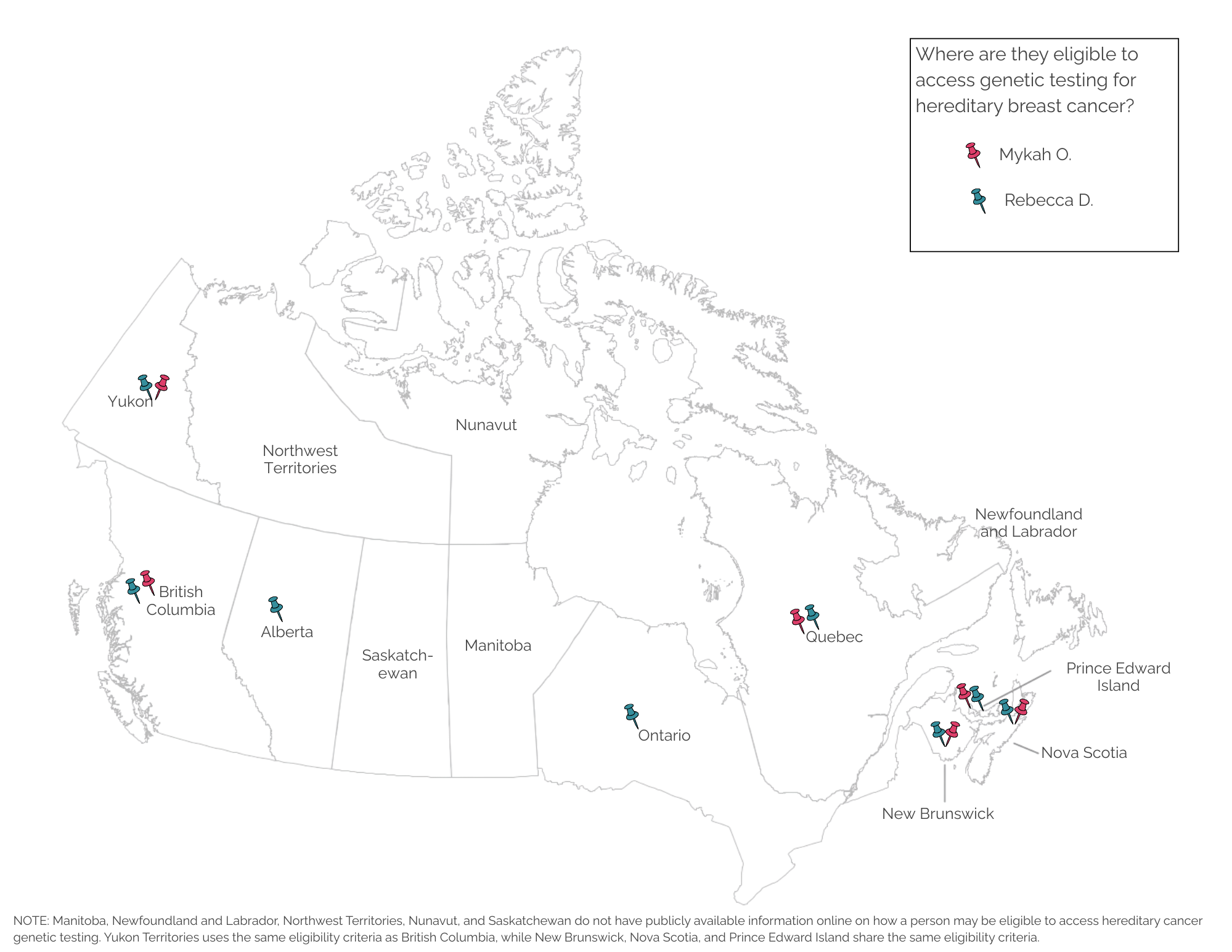
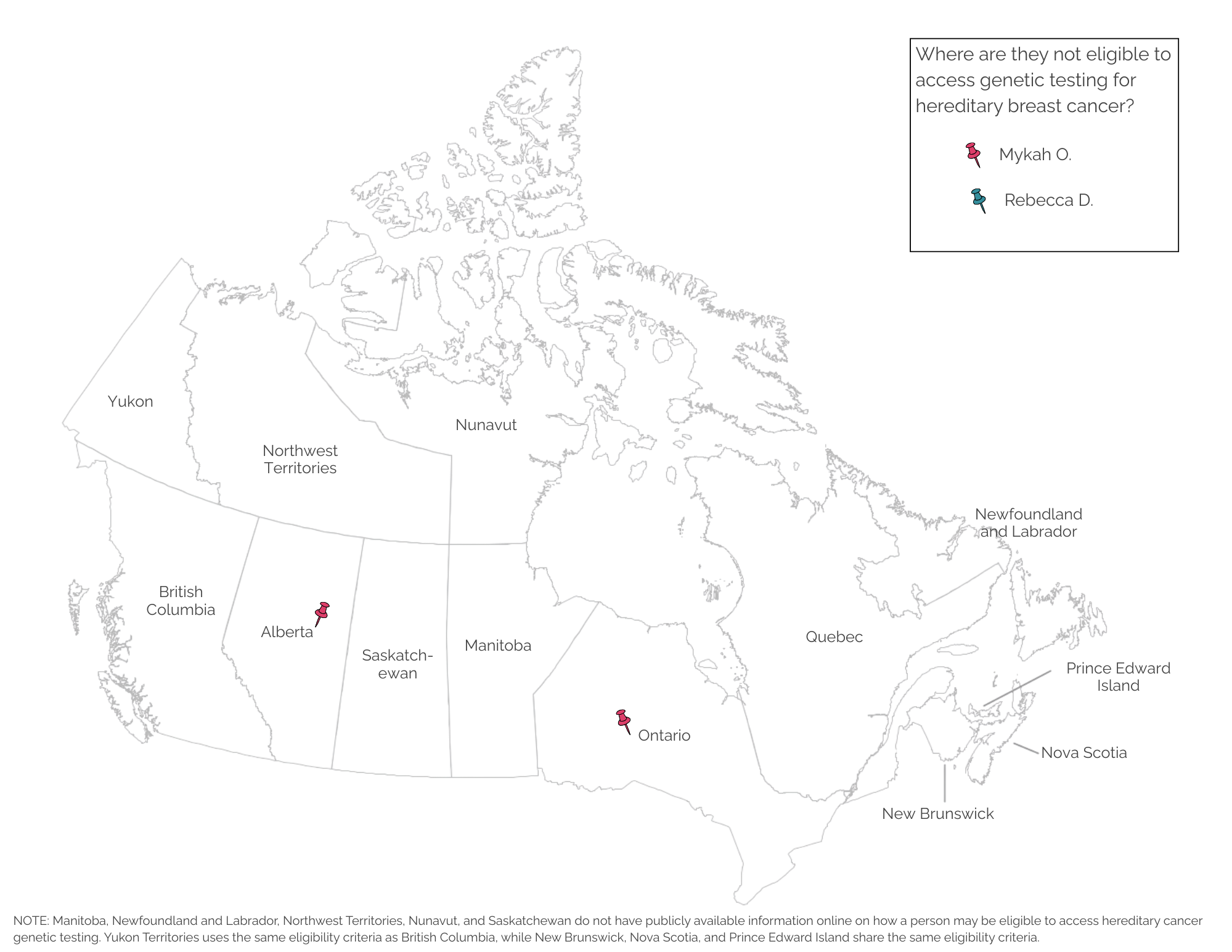
In this blog series, we see just how much access to healthcare in Canada can be determined simply because of where a person lives. Canada needs eligibility criteria that are the same across the country. Individuals concerned about hereditary cancer and people diagnosed with breast cancer cannot be at the mercy of their postal code determining their health and access to adequate healthcare. While we see that Rebecca is eligible to access genetic testing in all provinces and territories that have publicly available information on their criteria, this is not always the case.
Not only should access to genetic testing be the same across Canada, but it should also be updated to ensure it reflects our latest knowledge of hereditary breast cancer and gene mutations. Sources like the Canadian Recommendations for Germline Genetic Testing of Patients with Breast Cancer: A Call to Action should be consulted to develop standardized, inclusive, guidelines that don't let people fall through the cracks. Tied in with this is the importance of testing a large number of gene mutations that have been associated with breast cancer, not just the BRCA1 and BRCA2 gene mutations. Once developed, the eligibility to access genetic testing should be posted online and made publicly available by all provinces and territories.
Additionally, where the five women we spoke to may or may not be able to actually access genetic testing is just for illustrative purposes. We only show where they meet the eligibility criteria that has been set and made publicly available by each PT. It does not reflect their actual access to genetic testing for hereditary cancer as there may be further access criteria. For example, in some places a person can get genetic testing automatically if they meet the criteria, while in others, a referral from a doctor might be needed. This was shown in Mykah’s case where she does not meet the eligibility criteria in Alberta, where she lives, but was still able to get tested; although with a lot of bumps along the way.
Genetic testing is an important part of both prevention and treatment. It is important that access to genetic testing in Canada reflects this.



 Receive updates by email

