
By Jaclyn Carter
 Despite access to a social healthcare system that’s meant to cushion all of us who make an unintended stop in Cancerland, I learned very quickly following my breast cancer diagnosis that the financial hits we take as patients differ drastically. No, we’re not shopping around for an oncologist who will accept our health insurance; we’re not left to file appeals with our insurance providers or risk paying out of pocket when they reject our oncologists’ requests for critical scans; we’re (usually) not begging for compassionate access to experimental drugs approved for treatment elsewhere; and we’re not weighing the cost of life-extending treatments against bankruptcy. But we’re also not all undergoing treatment with the same financial means, and this can have a substantial impact on our physical and psychosocial health outcomes.
My breast cancer diagnosis, when I was just thirty-three, was a complete and utter shock to my system. I didn’t know panic until I went toe-to-toe with it that day in the biopsy room. I didn’t know anxiety until I stopped sleeping and started doom-scrolling the #breastcancerunder40 hashtag in the middle of the night. I didn’t know grief until I walked into the hospital during the height of a global pandemic to undergo a double mastectomy by myself. I didn’t know fear until a new zap of pain—from stress or surgery or chemotherapy or radiation—had me convinced that my cancer had taken up residence at a new site in my body, and that this time it would for sure kill me. But I did know that I was privileged to have access to excellent benefits through my employer—benefits that supported sick time and long-term disability, not to mention job security, partial coverage of expensive fertility-preserving medications, and rehabilitation services for my body and mind long after active treatment ended.
I accessed my benefits with a level of desperation that was rooted in the debilitating fear my diagnosis incited. I explored every complementary tool at my disposal because the aforementioned doom-scrolling, and a very toxic and predatory wellness industry, told me that the standard of care was insufficient to supporting my full recovery. One avenue I explored was naturopathic support to complement my oncological treatments. To be clear: I didn’t and still don’t believe they have any business touting themselves as replacements for the standard of care, but many folks I shared the infusion room with at the naturopath’s office clearly did, and at my most vulnerable I wondered if they knew something I didn’t.
In this vulnerable state, I felt empowered to have found a naturopath who was treating other young women with breast cancer. I valued her perspective and expertise and felt comforted by the regimen she suggested—biweekly vitamin C infusions on my weeks off from dose-dense chemotherapy, and daily intake of a few supplements to help support my body during treatment. Depending on who you ask, vitamin C’s impact ranges from softening the side effects of chemotherapy to improving its efficacy to zero benefits whatsoever. It is not standard of care, and thus it is not covered by Canadian healthcare. A single infusion while I was undergoing treatment cost me $200 per dose. But choosing to use my family’s health spending account in this way felt like a necessary step in my survival—like if I didn’t do it when I knew it might have some benefit, I would somehow be doing a disservice to my longevity.
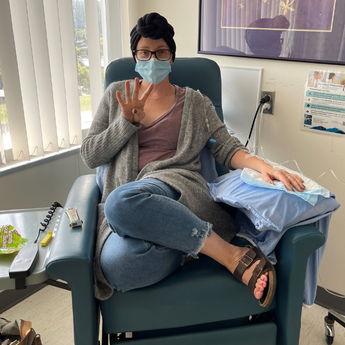
When I got to my first appointment in the infusion room—a cramped area with floor-to-ceiling windows that gave the illusion of vastness despite side-by-side leather recliners with less space between them than pedicure chairs at a run-of-the-mill nail salon—the naturopath started referring to my infusions as “weekly.” I remember thinking, I thought we discussed biweekly infusions… When I asked her about the sudden change, she said she had always recommended weekly doses. I chalked up the error to my own anxiety and exhaustion and proceeded to show up every week for the duration of my chemotherapy treatments.
When I arrived for my final vitamin C infusion, I was thrilled—one less appointment, one less painful needle poke, one less visit to a place I had grown viscerally averse to. And then the naturopath mentioned that since I would start radiation in only a few weeks’ time, and since vitamin C had also shown benefits for reducing symptom burden from radiation, I might as well just keep coming every week to best prepare my body for this next step, and then keep coming weekly during and after radiation to help temper its negative side effects. As the words “I’ll have to check what my insurance will pay for…” came out of my mouth, I remember thinking I have never felt less like a patient or more like a paycheque than I do right now. I never returned to her office, and not once after that last dose did she reach out to check in on me or ask why I hadn’t come back.
Whether the experience was inherently predatory or just appears to me that way looking back on it, I feel such empathy for the girl who made decisions about her treatment plan that were rooted in fear. In hindsight, they were also rooted in the fact that I had access to funds that wouldn’t force me to choose between vitamin C and rent. I was immensely vulnerable when I turned to this person for help, and in all likelihood, I was knowingly taken advantage of when they learned I had a pool of funds to pull from. And though my vitamin C debacle is a poignant example of the potentially predatory “care” that complementary medicine can morph into, it’s also a striking reminder that financial inequities can still greatly impact one’s journey through the healthcare system, even if we’re not walking out of our local cancer centre with a hospital bill.
Many of the recommended supports that help us get through treatment are covered only through employer or private insurer benefits, if they’re covered at all. Acupuncture might help with the crippling bone pain that chemotherapy can cause. It might also temper hot flashes. Deep tissue massage can help break up the fascia that radiation hardens and renders permanently painful. Physiotherapy can help you return to full mobility following surgery. Long-term disability benefits can give you time to properly recover from multimodal treatment before you head back to work. Psychology can help you manage your fear of recurrence or process the trauma you experienced or the rubble of the relationships ruined by your diagnosis.
More than one person I know was obligated to work through active treatment because they couldn’t afford to live or support their children otherwise, or who had zeroed out their savings or turned to crowd funding to cover their living expenses while they couldn’t work and had no other sources of income. We don’t all have access to the same long-term disability, to job security, or even to intermittent, paid sick time when cancer interrupts our regularly scheduled programming. We don’t all have access to the same prescription medication coverage, whether because of differences in employer benefits (if we have these at all) or discrepancies in drug coverage from province to province. We don’t all have access to reasonable transportation to and from appointments, or to healthy food that supports us when we’re depleted, or to childcare or costly fertility preservation. We don’t all have caregiver support. We don’t all get the same psychosocial assistance or oncological rehabilitation support, if we get access to these services at all. And when our medical providers recommend treatments like acupuncture or massage therapy or physiotherapy to help us manage our symptoms or recover from major surgical procedures—to literally preserve or recover some of our quality of life—not all of us will be able to access these services with the regularity or consistency that’s typically needed for efficacy, if we can afford one appointment at all.
No two cancer experiences are the same. Yes, this is in large part due to the fact that no two cancers behave the same way. But it’s also due in large part to the financial means cushioning us in the boxing ring when cancer takes the first punch, and then the second, and then the third… Our fights entail more than the killing of cancer cells; they’re about protecting our humanness and our quality of life. And unfortunately, access to these protections isn’t based solely on whether we had a complete response to treatment. I don’t regret those weekly vitamin C infusions—not because I believe they somehow gave me a leg up in my fight against breast cancer, but because they’ve shaped the kind of advocate I want to be. One who supports data-driven decision making and the cultivation of trust with reliable medical providers. One who advocates for financial assistance to, at minimum, preserve the dignity of those in need. And one who believes cancer care affects our whole selves, not just a cluster or two of rogue cells.

 Receive updates by email

